
Fresno City Directory Holdings
Fresno has no municipal clerk or city archive that keeps its own directory shelf. The practical historical collection is a Fort Bend research trail: Richmond and Rosenberg telephone books, George Memorial Library’s local-history material, and cataloged state and university holdings. Look for the label printed by the source rather than forcing every result under Fresno. A newspaper may say “of Fresno,” while an older directory uses Richmond or Rosenberg as its service area. Keep that original label beside the Fresno CDP and Fort Bend County description when comparing records.
| Collection | Years | Where held | Access |
|---|---|---|---|
| Richmond Telephone Directory | 1918–2005, selected issues | UT Center for American History citation | Consult the cited holding |
| Rosenberg-Richmond directory catalog | 1962, 1982, 1986 | Texas State Library catalog | Catalog and collection access |
| Richmond and Rosenberg telephone directory | 1964 | Portal to Texas History | Digitized, page-by-page |
| Fort Bend local-history directories | Years vary | George Memorial Library | Ask Genealogy staff |
The university’s Richmond series is uneven, not a complete annual run. Its cataloged service area names several Fort Bend communities but does not name Fresno, so a Fresno household entry cannot be promised before the relevant page is checked. The Texas State Library catalog directs Richmond researchers to Rosenberg-Richmond listings. These gaps make a date range and an alternate place name important parts of a directory search.
Fresno Historical Research at George Memorial
The Genealogy and Local History Department on the second floor of George Memorial Library is the best local starting point when an online directory does not answer a Fresno question. Its collection reaches across Fort Bend and nearby counties, with census indexes, local histories, photographs, vertical files, cemetery material, newspapers, and family-history resources. The department also keeps Fort Bend Herald obituary material, though that database contains only obituaries published in the Herald. Ask staff to check a printed directory, newspaper microfilm, a vertical file, or cemetery register when a catalog or obituary search comes up empty.
The George Memorial Library Genealogy and Local History Department publishes its department scope, research contact, and current hours.
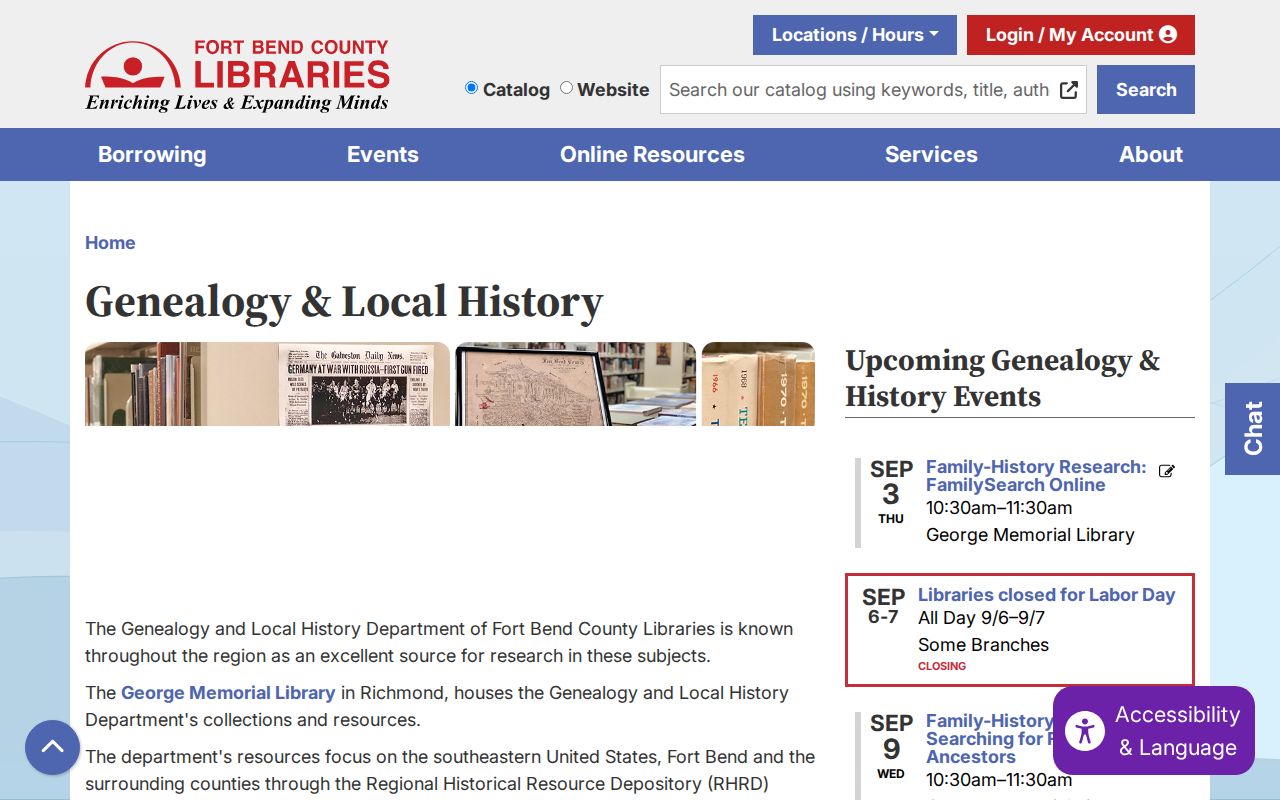
Its local-history department brings directories together with obituaries, cemetery compilations, and newspaper evidence, which helps test a Fresno historical lead against dated sources.
George Memorial Library is at 1001 Golfview Drive in Richmond. The published department schedule has included weekday evening and weekend hours, but the library asks researchers to verify current hours before visiting. The department phone is 281-341-2608. Fresno research belongs there because county-level collections replace the city-office records that an incorporated municipality might maintain.
Richmond Telephone Volumes Near Fresno
Telephone volumes supply the clearest dated directory spine for this part of Fort Bend County. The UT Center for American History citation lists issues from June and December 1918, January 1924, April 1927, March 1930, then a group of 1950s and 1960s volumes. Later holdings continue in selected years through March 2005. Publishers changed across the sequence, including Southwestern Telegraph & Telephone, Southwestern Bell, and SBC. Those changes describe the volume, not a change in Fresno jurisdiction.
| Early issues | June 1918, December 1918, January 1924, April 1927, and March 1930. |
|---|---|
| Mid-century run | Selected issues from May 1952 through June 1974, with a continuous 1962–1969 sequence listed. |
| Later issues | Selected volumes from August 1984 through March 2005. |
| Service-area caution | Richmond/Rosenberg coverage is not the same as a Fresno household roster. |
For years outside that citation, do not infer that no listing existed. Check George Memorial and the Texas State Library catalog, then use newspapers or a county record to bridge the missing interval. Note: a telephone listing is a dated subscriber lead, not proof that the subscriber occupied a particular Fresno address.
Fresno’s Digitized 1964 Telephone Volume
The Portal to Texas History’s digitized 1964 Richmond and Rosenberg telephone directory can be read page by page. It is useful for testing a surname, business, or old service-area address without assuming the volume contains every Fresno household. Research did not inspect a Fresno entry in the object, so treat a negative or positive name hit as a lead that needs a second dated source.
The scanned object offers a practical starting point for an exact page citation, while its Richmond and Rosenberg title explains why Fresno may not appear as the primary place label.
Reverse or criss-cross volumes are a separate question. No Fresno-specific address-to-subscriber run was found in the inspected official catalogs. Ask George Memorial or the university whether a surviving Richmond or Rosenberg volume includes street-order pages. Even if it does, pair a listing with a deed, tax record, voter record, obituary, or another independent source before calling it a residence match.
Reading a Fresno City Directory Entry
Read the title page and abbreviation key before copying an entry. A telephone directory may show only a subscriber name, number, and address, while another directory format can add a household role or business information. The research identified telephone-directory holdings, not a Fresno entry sample with occupation, spouse, owner, renter, or widow symbols. Do not supply those details from memory or assume that a mark used in another publisher’s book appears in a Fort Bend volume.
| Name | Copy the spelling, initials, suffix, and place label exactly as printed. |
|---|---|
| Address or number | Record it as a dated routing or subscriber lead, then compare it with the legal description or parcel record. |
| Telephone listing | Shows a subscriber relationship for the issue date, not a full household census. |
| Publisher and year | Preserve both, because title, service area, and coverage changed across the Richmond/Rosenberg run. |
- Criss-cross directory
- An address-ordered directory that may point from a street address to a subscriber. A verified Fresno run was not located.
- Householder index
- An index organized around a household name. Confirm that a particular volume actually includes one before relying on it.
- Abbreviation key
- The publisher’s explanation of symbols and shorthand, usually near the front of a volume. Photograph or transcribe it with the entry.
Fresno Directory Clues in County Archives
When a historical volume does not identify a family, move sideways to archival material rather than guessing. The Fort Bend County Historical Commission maintains photographs, documents, and artifacts. Its searchable archive categories include funeral records, oral histories, deeds, wills, genealogy, Bible records, tax assessments, and addresses. Those categories can preserve the name or legal-description trail that a telephone book misses. The volunteer-led office asks researchers to call 832-471-2525 or email HistoricalCommission@fortbendcountytx.gov before visiting.
The Fort Bend County Historical Commission archives describe the archive materials and contact route.
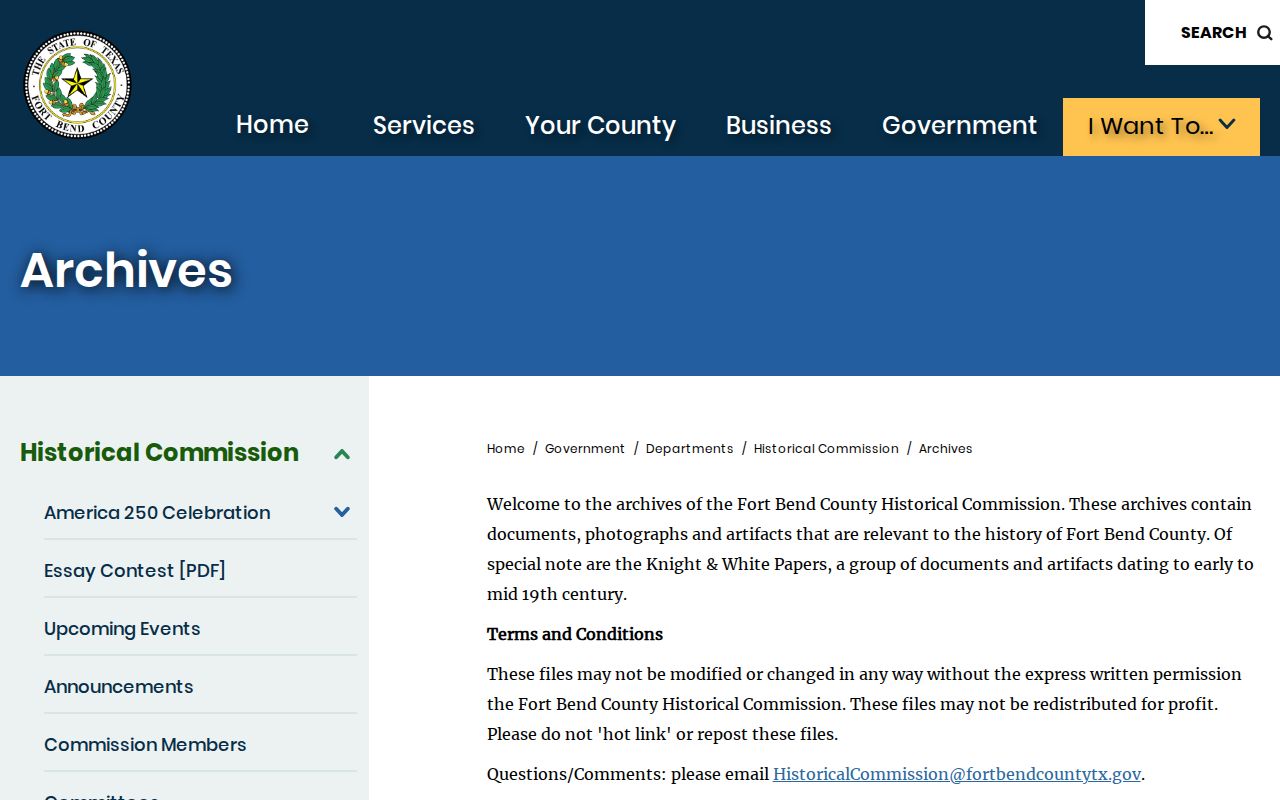
The archive complements Fresno directory research with county documents and historical categories that can explain an older address or family reference.
The Historical Commission catalog search accepts keyword, category, subcategory, historical period, and search terms. It is a discovery tool, not proof of identity. Match any result against its original document and date.
Tracing Fresno City Directory Households
Use one dated source at a time. Start with the first known spelling or address, then move through the available telephone years without filling in gaps. A person who disappears may have moved, changed a number, died, become unlisted, or simply fall in a year that was not retained. The next record should test one of those possibilities. For a current name that needs modern corroboration, the county and state sources used for a Fresno resident lookup are more useful than extending a historical listing into the present.
- Locate the surname or address in the closest available Richmond or Rosenberg telephone volume and record its title, year, and printed place label.
- Check the next available issue forward and backward, preserving initials, spelling changes, and address changes instead of merging similar names.
- Compare the address with a dated deed, plat, or appraisal account. A legal description can bridge rural land records and a later Fresno-style street address.
- Use the Fort Bend Herald obituary database, newspaper microfilm, cemetery registries, and vertical files to test a move, death, or family connection.
- For an older county trail, note the deed or probate volume and whether the evidence is a modern index, image, microfilm reel, or library transcription.
Fort Bend’s historical layer runs much earlier than modern Fresno subdivisions. The Texas State Library guide lists a deed index for 1837–1897, deed records from 1838–1886, a marriage index for 1837–1931, and a WPA naturalization index for 1854–1929. These are not city directories, but they make a valuable second track when a surname was recorded by county, survey, or rural road rather than Fresno.
Fresno Historical Dates and Older Records
Fort Bend County was created in 1837, and the County Clerk online-records route says historical material reaches back to 1821. The current Official Public Records interface is an access layer, not evidence that every older page is indexed by today’s name fields. For deep research, distinguish an online index from an image and an image from a microfilm reel. The County Clerk’s historical records and the Texas State Library microfilm guide are the fallback when the modern search does not expose an older person or legal description.
That deep-time record trail is especially important in Fresno. The county’s Livable Centers study distinguishes newer subdivisions such as Teal Run and Andover Farms from older linear development called Old Fresno. A subdivision listing may respond to lot and block, while an older tract may require a survey, abstract, or deed-chain search. The historical shelf supplies household leads; county land and archive records supply the geographic bridge.