
Fresno Previous Residents by Era
Past Fresno households leave different kinds of evidence in different periods. Start with the property account and the current recorded deed, then work back through the grantor and grantee chain. When a modern search stops, the legal description can lead to older record books, microfilm, and historical collections. Telephone directories, newspapers, obituaries, and cemetery compilations add household and family context, but they should be dated and tested against the property trail. Fresno is an unincorporated Fort Bend County CDP, so there is no city archive to substitute for the county and library sources.
| Fresno source | Years or era | Where held | What it can show |
|---|---|---|---|
| FBCAD property account | Current appraisal context | Fort Bend Central Appraisal District | Owner, mailing and situs addresses, legal description, subdivision, and account identifiers. |
| Official Public Records | 1838 to present | Fort Bend County Clerk online library, counter, and mail service | Deeds, plats, liens, mortgages, easements, parties, and recording data. |
| Historic deed indexes and books | Index 1837–1897; deed volumes 1838–1886 | Texas State Library guide, microfilm, and Clerk historical materials | Earlier names and legal-description continuity when a web search is thin. |
| Richmond/Rosenberg telephone directories | Uneven holdings from 1918–2005 | UT catalog and local-history research channels | Subscriber and address leads for a dated period, not a complete resident list. |
| Obituary and newspaper resources | Fort Bend newspapers beginning 1911 | George Memorial Library | Dated death, family, event, and community leads that require corroboration. |
Use the era to choose the first stop. Recent questions usually begin with FBCAD and the County Clerk. Deep history begins with the legal description, historic deed index, or microfilm guide. A library lead is most useful after a parcel, name, or date gives it a narrow target.
Fresno Address History Starts With FBCAD
FBCAD supplies the present-day point of departure for a Fresno house history. Search by owner name, street number and name, Quick Ref ID, Geographic ID, subdivision, neighborhood, condo, or abstract. Write down the owner name and mailing address, the situs address and ZIP, the legal description, and the subdivision, lot, block, or abstract details if shown. The owner mailing address may be elsewhere. It proves an appraisal-account and tax-mailing relationship, not that the owner lives at the Fresno property.
That distinction keeps the trail honest. The situs address is the physical property reference. The legal description connects the account to a recorded plat, survey, or deed. The current owner name becomes a grantee search term at the County Clerk. If an appraisal display is incomplete, FBCAD accepts a written open-records request by mail or at openrecords@fbcad.org; its guidance describes a response within 10 business days. Property owners can request web-display opt-out for their name and mailing address, while underlying public records remain subject to law.
Fresno has a practical three-address problem: the appraisal situs address, owner mailing address, and USPS delivery address can differ. Add the deed’s legal description as a fourth note. Carrying all four forward avoids losing a property when a postal label or street form changes.
Fresno Deed Chain for Earlier Owners
The Fort Bend County Clerk’s Official Public Records search is where a Fresno address-history inquiry turns from an address lead into a dated ownership chain. The index offers Party Name, Grantor, Grantee, Date Filed, Instrument Number, and Document Type. Search the current FBCAD owner as grantee, find the purchase deed, and read the grantor, legal description, recording date, and prior-instrument reference. Then search the seller as an earlier grantee. Continue with the same legal description instead of relying only on the current street number.
The County Clerk online record-search page is the official route to the available public record channels.
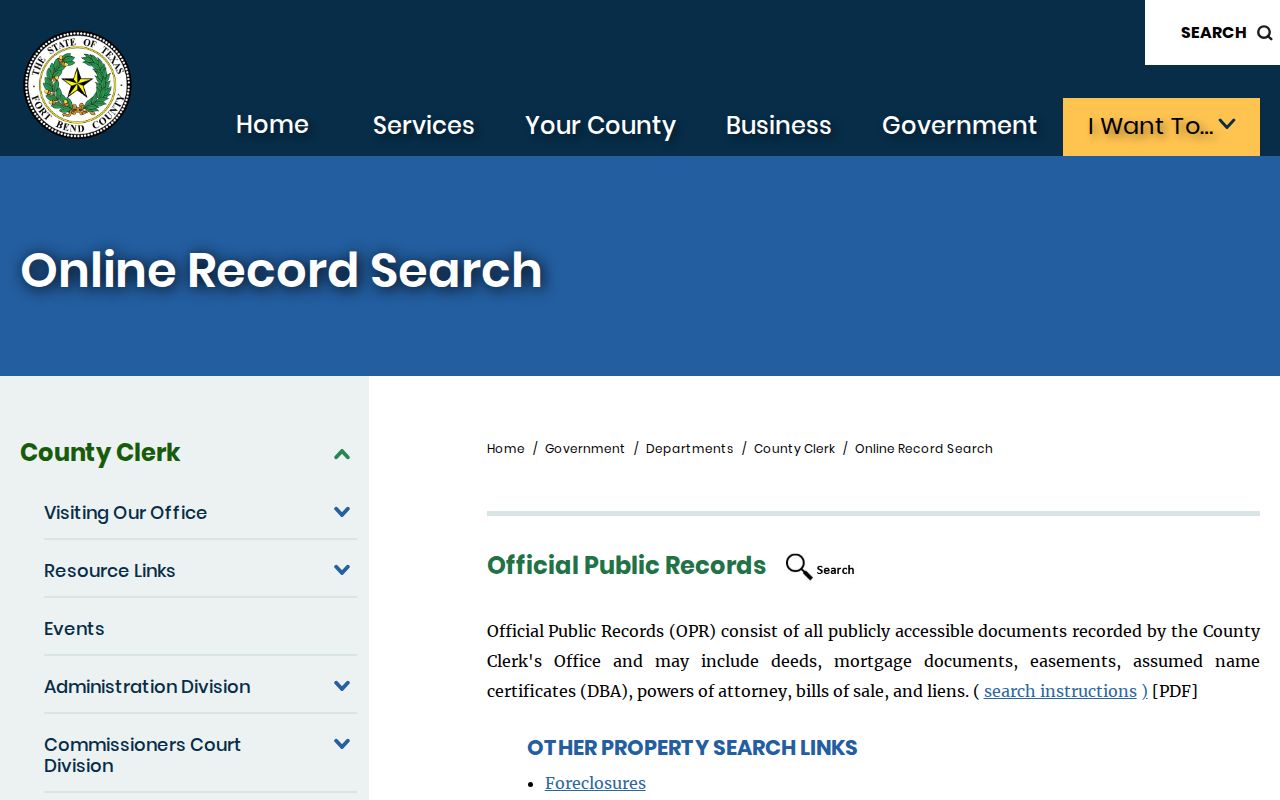
Results are leads, not a substitute for the official record. The Clerk’s online images are marked “UNOFFICIAL DOCUMENT.” When a copy is needed, plain copies are listed at $1 per page and certified copies at $1 per page plus $5 per document. The Richmond counter and mail requests are available alternatives to the online index; include the instrument number in a mailed request. Clerk staff cannot perform legal research or title advice.
- Open the current Fresno account in FBCAD and copy the legal description with the owner and property identifiers.
- Search that owner as grantee in Official Public Records and locate the deed that brought the property into that name.
- Copy the grantor, recording date, instrument number, document type, legal description, and any earlier instrument reference.
- Search the grantor as an earlier grantee. Compare the legal description before accepting the document as the prior conveyance.
- Repeat through warranty deeds and estate transfers. Check releases, liens, easements, and deeds of trust so a financing document is not mistaken for a change in ownership.
Fresno Past Address Changes
Legal descriptions carry a Fresno property through address changes better than an address alone. New Fresno subdivisions, including Teal Run and Andover Farms, are suited to lot, block, section, and plat searches. Old Fresno is described in county planning material as older linear development with vacant tracts and limited commercial or industrial activity. Its trail may use a rural road, an abstract or survey, a historic landowner, or a county-seat reference rather than a current subdivision address.
Fresno roads can also cross a record boundary. County street-range material shows portions of Trammel Fresno Road with Fresno and 77545 coding, and another range tied to Missouri City and 77459. The USPS postal city, the CDP label, and the legal parcel jurisdiction are not interchangeable. Preserve the original place label shown by a source, then compare it with the address range and legal description.
- Grantor
- The party transferring an interest in a recorded document.
- Grantee
- The party receiving that interest. A grantee search can expose the earlier purchase that starts the next backward step.
- Chain of title
- A dated sequence of recorded conveyances for the same property, checked by legal description and document type.
- Legal description
- The lot, block, section, abstract, survey, or other land description that anchors a property even when its street address changes.
Note: No verified Fresno street-renumbering or renaming list was found. Bridge old and current forms with the plat, legal description, county GIS, CenterPoint verification, and the street-range file.
Fresno Historic Deed Books
Fort Bend’s land-record story reaches far before modern Fresno subdivisions. The Texas State Library guide identifies a deed index for 1837–1897 and deed-record volumes for 1838–1886, including volumes A through R. The County Clerk says its historical collection reaches to 1821, while the online library is described as 1838 to the present. That does not mean every older document has a modern party-name image or the same level of online indexing. When the web trail ends, move deliberately to the historic image books, microfilm, or the Clerk’s historical materials.
The legacy Fort Bend deed index captures the grantor, grantee, date, instrument, and document-type approach used to preserve a backward chain.
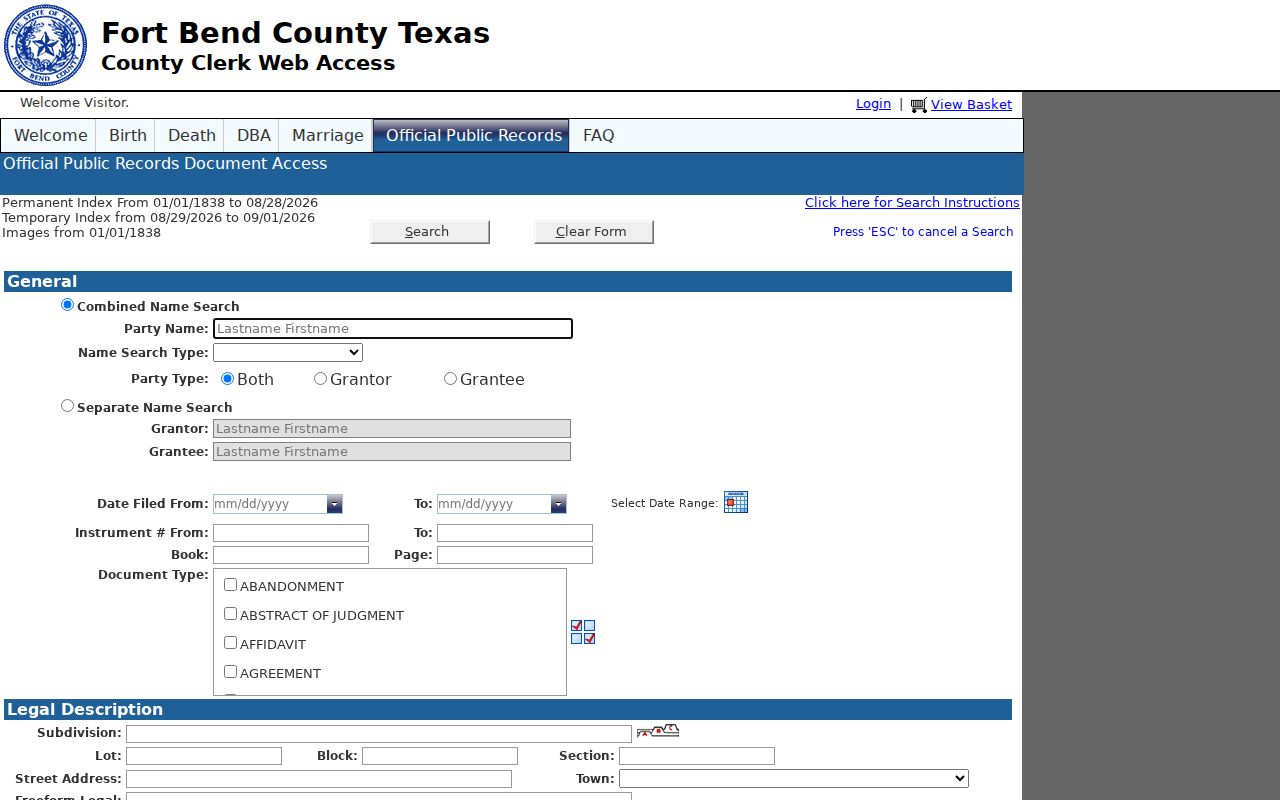
A deed book can establish a land connection, but it does not by itself establish who occupied a home. Mark whether each item is a modern index result, an image, a microfilm reel, or a library transcription. This keeps the evidentiary gaps visible and makes a later review possible.
Historic probate adds another bridge. Fort Bend historic probate search covers 1838–1956, and the Texas State Library guide lists probate minutes from 1838–1885 plus unevenly indexed probate records. Estate transfers can explain a change in ownership that does not look like a conventional sale.
Fresno Directory Years for Past Households
Telephone directories are a household lead layer, not the property anchor. UT’s Richmond Telephone Directory holdings begin in 1918 and continue in uneven years through 2005. The cataloged service area includes Richmond, Rosenberg, Arcola, Beasley, Fulshear, Sugar Land, and other communities, but it does not name Fresno. The Texas Portal to Texas History offers a digitized Richmond and Rosenberg telephone directory from 1964. Do not promise a Fresno entry or turn a subscriber into proof of residence without seeing the page and corroborating it.
The digitized 1964 Richmond and Rosenberg telephone directory is a page-by-page historical lead.
The volume can supply a spelling, subscriber address, or date to test against a deed, obituary, or other county record. Exact Fresno occupant extraction was not captured in the inspected material, so any possible match remains a lead.
For a household trail, pair a dated directory entry with the federal census record available for the era, then compare names, place labels, and property evidence. Ask the Genealogy & Local History Department at George Memorial Library for vertical files, newspaper microfilm, printed cemetery registers, and any confirmed reverse or criss-cross directory. The collection details are retained on the Fresno City Directory page.
Fresno House-History Endpoints
When the deed and directory trail stops, use Fort Bend’s historical shelf to test the last known name and period. George Memorial Library’s Genealogy & Local History Department holds the Fort Bend Obituary Database for obituaries that appeared in the Fort Bend Herald, newspapers beginning in 1911, vertical files, cemetery material, photos, and local histories. Search the obituary database through the library catalog. If the online result is absent, ask staff to check microfilm, vertical files, and printed cemetery registers.
The Fort Bend County Historical Commission adds photographs, documents, artifacts, oral history, deeds, wills, genealogy, Bible records, tax assessment, and address categories. It is volunteer-led, so call 832-471-2525 or email HistoricalCommission@fortbendcountytx.gov before visiting. The District Clerk historical electronic index and minute books from 1821–1980 are another deep-time option when a modern name search fails.
These sources can place a person in a Fresno-related community story, but each item needs a date, page or image reference, and a clear distinction between ownership, a subscriber listing, and occupancy. A probate file or obituary may explain a transfer after someone left the address without demonstrating where every family member lived.
Limits on Fresno Previous Residents Claims
House-history research should describe evidence, not fill gaps with assumptions. A present FBCAD owner may not be the occupant. A telephone subscriber may be a business or former resident. An obituary can use a community label instead of a street address. A same-name deed record needs a matching legal description, date, and another independent attribute. Fresno’s county and postal labels can also shift, especially on roads that cross into Missouri City coding.
Texas protections matter in house-history work. The Address Confidentiality Program can give qualifying victims a substitute address and mail forwarding. County and state records may redact protected details. Keep personal data to what is necessary for a lawful property, family-history, heir, or civic research question. If an issue raises a safety concern, use the Sheriff, court, or victim-support route rather than contact information found in an old record.
Lawful use. Fresno house-history research is appropriate for family history and personal curiosity. Do not use records or historical leads to stalk, harass, intimidate, dox, or harm any living person.